Insight
AI Is Becoming
Multiplayer.
Why the next phase of agentic AI will redesign teams, handoffs, and shared outcomes rather than only individual tasks.
The first wave of generative AI was intensely personal.
One person opened a chat window. One person provided the context. One person received the answer. Even the more advanced versions of this pattern, personal research agents, coding agents, or AI chiefs of staff, were generally designed for an audience of one.
That created meaningful individual leverage. But organizations do not create value as collections of isolated individuals.
Most consequential work happens between people. It moves through shared context, decisions, handoffs, review, negotiation, approvals, systems, and responsibility for a common outcome.
That is why the next phase of AI will be multiplayer.
From individual leverage to team capability
The shift begins when AI-generated work is no longer confined to a private chat. Outputs enter shared workflows. Context becomes organizational memory. Feedback becomes participation, and individual leverage becomes team capability.
But multiplayer AI should not be reduced to several people watching the same agent session.
The real change is deeper. The unit of design moves from a person and their assistant to a team and the outcome it owns.
Most AI tools optimize work inside a role. Agentic Business Engineering redesigns the work between roles.
That requires us to distinguish three forms of multiplayer work.
Multiplayer delivery happens when internal experts, external partners, and agents build a system together. The work combines domain knowledge, engineering, operating experience, prototypes, review, and deployment evidence.
Multiplayer workflows emerge when multiple roles share context, work state, decisions, approvals, and responsibility for an outcome. This is where an agent stops being a private productivity tool and becomes organizational infrastructure.
Multiplayer interfaces allow several people to inspect, steer, review, or take over the same agent session. This can be powerful, but it is only one possible interface for a multiplayer system.
A project can therefore be multiplayer before the interface is.
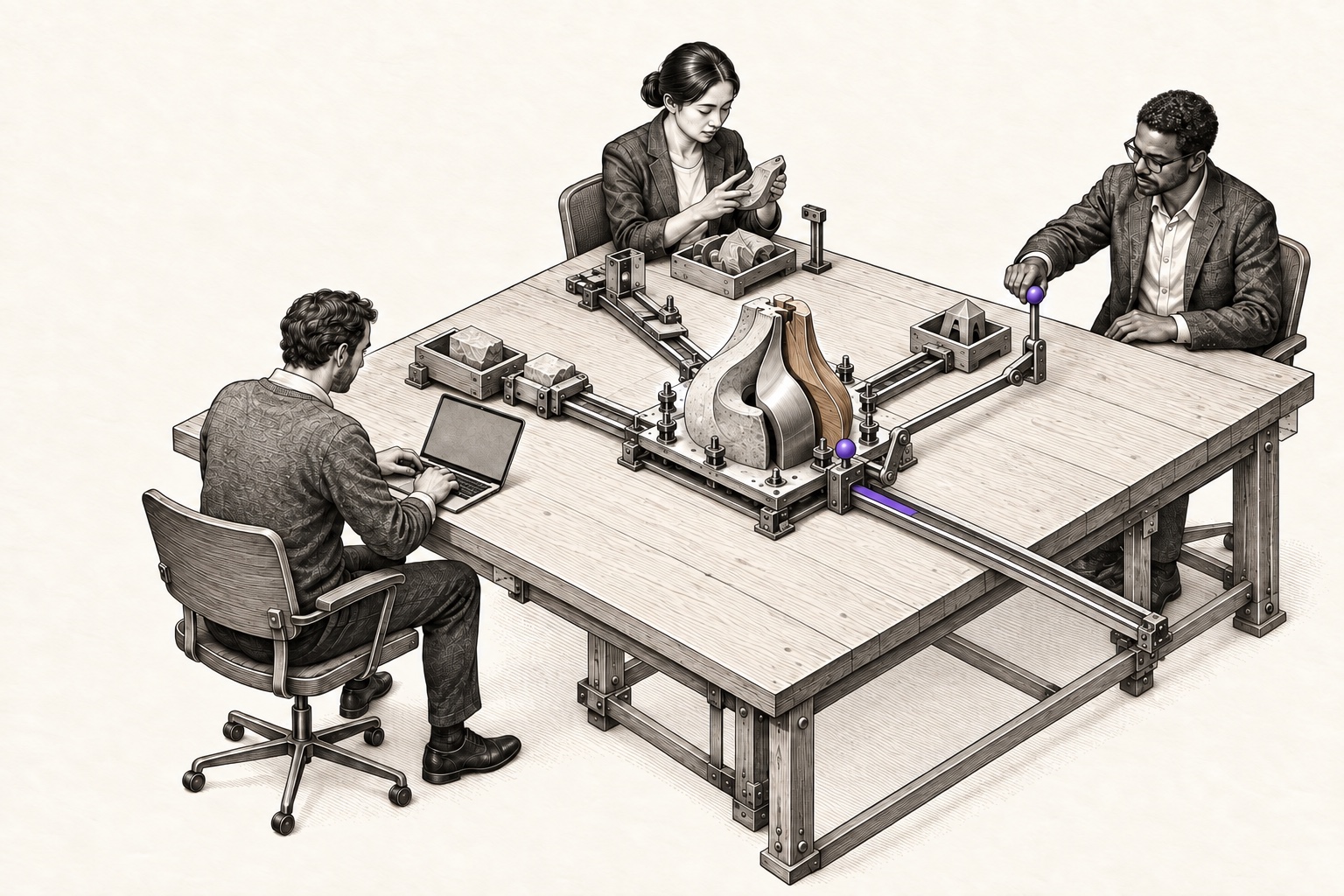
The interface may belong to one person. The capability belongs to the organization.
Single-player moments inside multiplayer systems
This distinction has become increasingly visible in the work we do.
Consider an operational application that helps discover suppliers, collect documents, compare options, identify missing evidence, and prioritize exceptions. One employee may interact with the application at a time. But the outcome depends on domain experts, administrators, suppliers, reviewers, regulatory requirements, management priorities, and a shared view of current state.
The value does not come from making one buyer type faster. It comes from improving how the entire system coordinates around a procurement outcome.
The same pattern appears in personalized customer experiences. A museum visitor may have an individual conversation with an adaptive guide and choose which stories to explore. Behind that encounter sits institutional knowledge maintained by curators, operations, service teams, commercial teams, and governance owners. The interaction is personal, but the capability and the customer insight it creates belong to the organization.
These are single-player moments inside multiplayer operating models.
The work between roles
The dominant enterprise AI question has been: how can this employee perform this task faster?
That question naturally produces assistants for writing, research, analysis, presentation creation, coding, and administration. Each can create value. But the workflow around the task often remains unchanged.
The more consequential question is different:
How should work move between people, systems, and agents once parts of execution can be delegated?
This exposes a larger opportunity. Delays often sit between functions rather than inside tasks. Context is repeatedly explained. Different teams maintain incompatible versions. Approvals arrive without the evidence needed to decide. Exceptions lose their owner. A handoff removes the assumptions that made the previous step intelligible.
What a multiplayer agentic system requires
Shared context is necessary, but it is not enough.
A reliable multiplayer system needs persistent work state. Trusted participants must be able to see what the agent did, which sources it used, what assumptions it made, and which decisions remain open. One person must be able to begin work and another must be able to continue without copying a transcript or starting again.
Permissions become more important, not less. Different participants may be allowed to view, edit, approve, or execute different parts of the workflow. A shared agent acting with one person's access can easily become a security problem for everyone else.
Conflicting instructions also become an operating-model issue. When sales, operations, legal, and finance want different things, the agent cannot solve the disagreement by averaging their prompts. The organization needs explicit decision rights, escalation paths, and an owner for the final outcome.
Multiplayer AI therefore requires:
- context owned by a team, project, or process;
- persistent and observable work state;
- role-based access and approval rights;
- explicit handoffs and takeover;
- evaluation, review, escalation, and rollback;
- traceability from action to source and decision;
- and an Application Owner accountable for performance and improvement.
Without these elements, multiplayer can simply distribute confusion more efficiently.
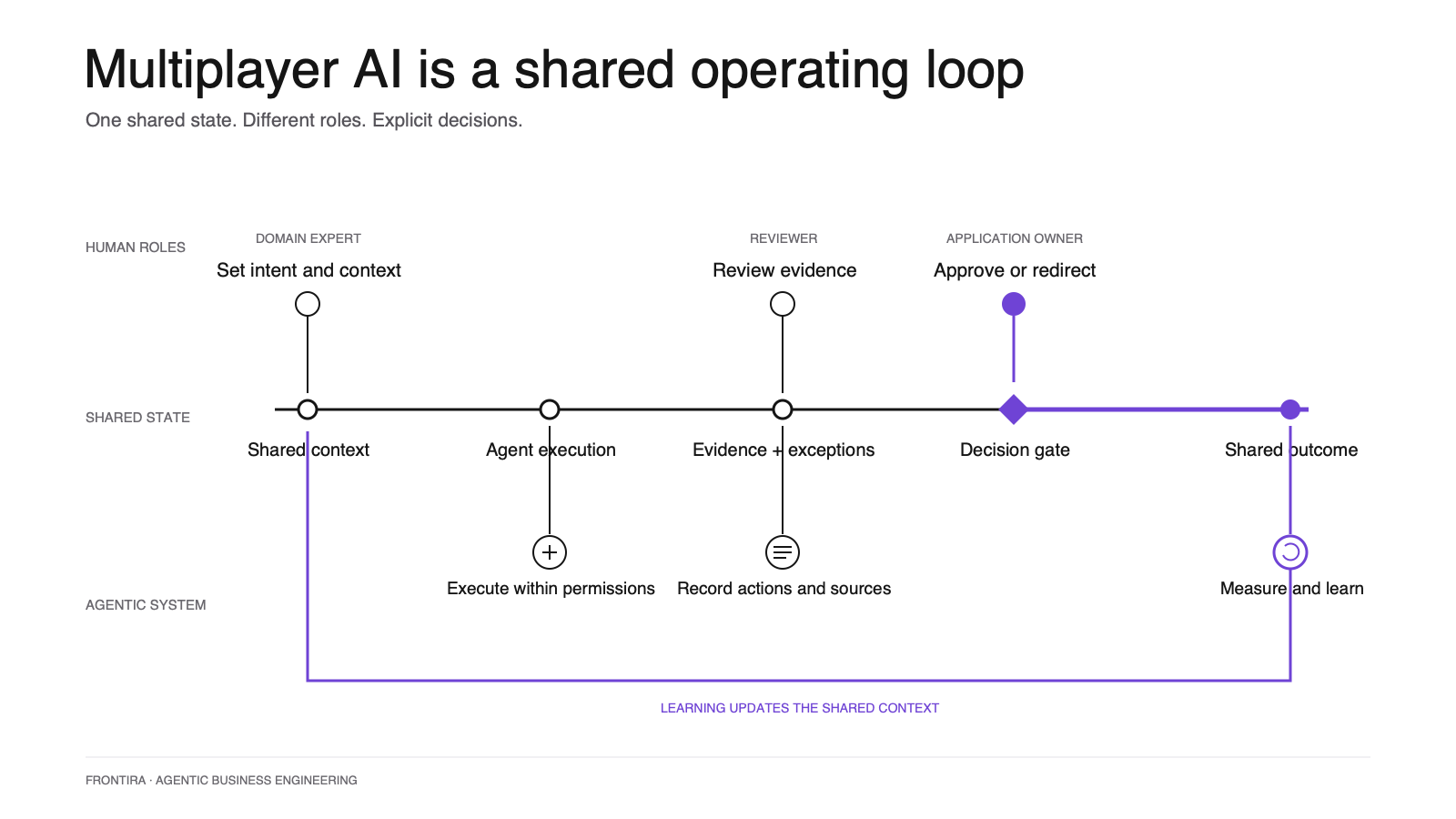
One shared state. Different roles. Explicit decisions.
Where should companies start?
Six criteria help identify strong shared-agent opportunities: shared need, the cost of stale context, permission sensitivity, verifiable results, handoff density, and shared-outcome leverage.
The first four establish whether shared agentic work is necessary and governable. The final two reveal where redesigning coordination can create meaningful value.
Handoff density: How often does the work move between roles, tools, teams, or organizations? Repeated explanation and context loss are strong signals that the current coordination architecture is expensive.
Shared-outcome leverage: Does better coordination improve something economically or strategically meaningful? Collaboration is not the objective. A better customer, operational, commercial, or societal outcome is.
The strongest starting point is rarely the workflow with the largest number of people. It is the workflow where shared context, repeated handoffs, checkable outcomes, and clear ownership combine into a bounded opportunity.
Build one shared capability around that outcome. Let at least two roles use it in real work. Observe where context breaks, where permissions become unclear, where judgment is needed, and where the agent genuinely reduces coordination.
Then use that evidence to design the next version.
Multiplayer AI and organizational maturity
Multiplayer AI also provides a useful way to understand organizational maturity. The Frontira Agentic Maturity Scale does not ask how much AI a company uses. It asks how deeply AI has changed how the business creates value.
Level 1: Individual AI use. People use AI personally for writing, research, analysis, or other isolated tasks. Individual productivity may improve, but the organization and its workflows remain unchanged. This is predominantly single-player AI.
Level 2: Assisted workflows. Teams add AI to existing processes through copilots, search, summaries, service support, or reporting. Several people may use the same tools, but the work still moves through the old roles, handoffs, and measures. Shared access alone does not make a system multiplayer.
Level 3: Redesigned workflows. Work is rebuilt around collaboration between people and agents. Shared context, decision points, review gates, escalation paths, responsibilities, and handoffs become explicit. This is where multiplayer AI begins to change how the team operates.
Level 4: Agentic operating model. The organization can build, govern, measure, and improve agentic workflows repeatedly across functions. Teams have maintained context, role-aware permissions, accountable owners, evals, review, escalation, and lifecycle management. Agentic systems become part of operations rather than a collection of experiments.
Level 5: Agentic Business Engineering. Agentic capabilities reshape the business itself: its customer experience, value creation, roles, metrics, products, and organizational rhythm. Business logic, domain knowledge, data, tools, agents, and human judgment become adaptive systems that the organization can continuously redesign.
The progression changes the unit of design. At Level 1, it is the individual and their copilot. At Level 3, it becomes the team and its workflow. At Levels 4 and 5, it becomes the operating model and ultimately the business itself.
This does not mean every interaction becomes collaborative. People still need private thinking, personal agents, and individual workspaces. Nor should every meeting, disagreement, or conversation be automated. Some coordination creates trust, interpretation, negotiation, and collective judgment.
The goal is not to remove the work between people. It is to distinguish valuable collaboration from avoidable coordination and design the system accordingly.
The work between us
The first chapter of enterprise AI asked who should receive a tool.
The next chapter asks which shared outcomes deserve a system.
That shift changes the architecture of AI projects. It brings context, visibility, permissions, handoffs, evaluation, and ownership to the center. It also changes how internal teams, external partners, clients, and agents work together while building.
The future of AI at work will not consist only of better individual assistants. It will include shared agentic systems that teams can inspect, steer, trust, and improve together.
The most valuable work has always happened between us.
AI is finally moving there.